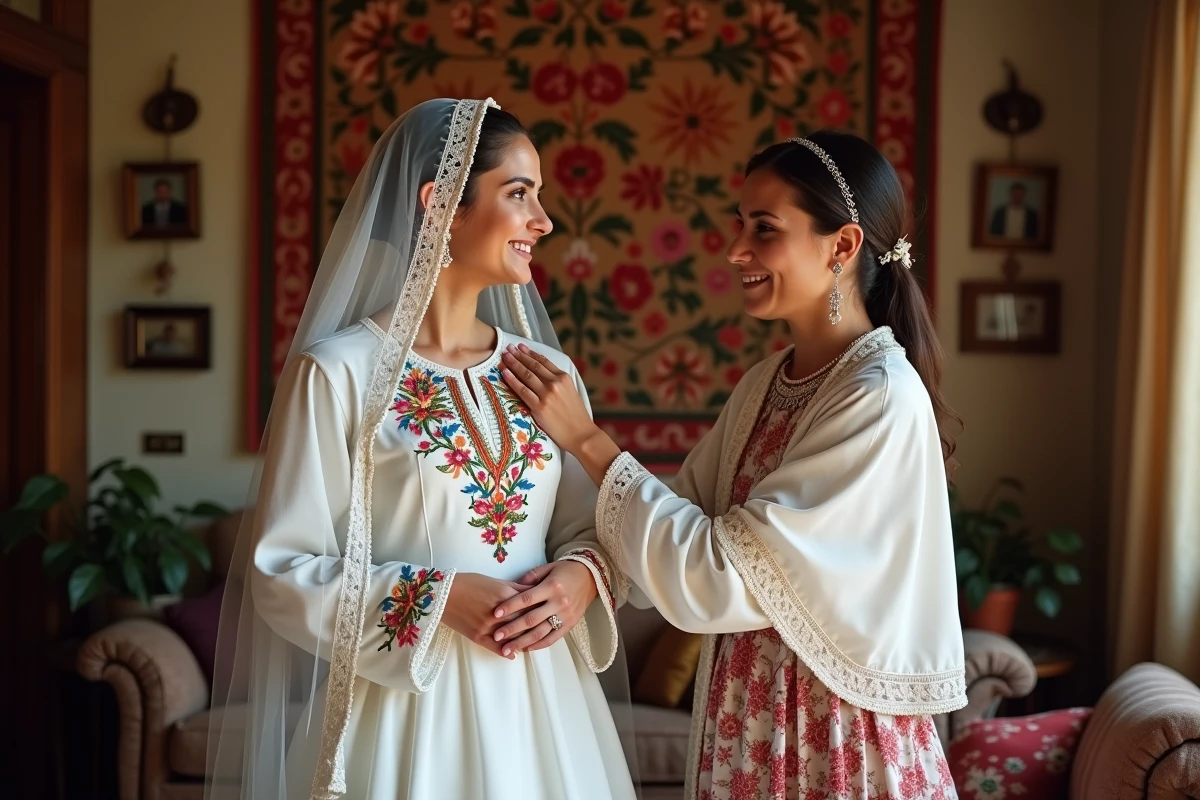
An engagement ceremony can be interrupted by a simple word, without the group being moved. But if a marriage takes place without the families’ approval, it’s the slamming of a door, an internal exile, a collective rupture. The age set by law sometimes fades before custom: some unite well before reaching adulthood. It also happens that a family refuses the dowry, a strong gesture, a sign of independence or a desire to break free from the gaze of the elders.
Religious marriage and civil union often intertwine: the priest is not always present, the rituals vary according to families, sometimes without any official, but never without the heavy gaze of the group. These weddings, moreover, shine as much for their scale as for the boundaries that are not crossed: strict separation of men and women, sometimes no drop of alcohol, and a social rigor that no one questions.
The unique place of marriage in Gypsy culture in France
In Gypsy culture, marriage embodies much more than a simple commitment between two people. It is a cornerstone for the entire collective. Honor, solidarity, and purity are held in the highest regard. Here, the choice of spouse involves not only the immediate family but the entire community, ensuring the transmission of Gypsy marriage customs and traditions. Each couple inscribes their own story within a broader family chronicle, a narrative that unites the past and the present.
In Marseille, where Gypsy groups reveal their diversity, tradition does not freeze but transforms without ever disappearing. At every stage, the collective shapes the journey of the future spouses, laying down its rules, wishes, and demands.
To realize the presence of loved ones and the community, here is what often dominates the organization of the wedding:
- Parents intervene to guide the choice of the future bride or groom, sometimes in a very pronounced manner.
- The modalities of the union are discussed at length, often to ensure respect for the balance between families.
- The preparation of the celebration quickly becomes everyone’s business: every detail matters, every loved one has their place.
Young people sometimes find themselves needing to reconcile their own desires with the wishes of those around them. This is where the specificity of Gypsy marriage is expressed: between respect for elders, individual choices, and family solidarity.
The collective involvement is also measured by the scale of the celebration, the general mobilization for its success, and the attention paid to each person’s reputation. In Marseille, mutual aid and solidarity still hold authority: organizing a wedding for Gypsy families is to defend their cohesion and common identity, during a grand celebration that resonates well beyond the family circle.
What rituals and traditions mark the celebration of Gypsy marriage?
This type of marriage revolves around rituals that span generations, forging a unique identity for each event.
Everything begins with the engagement, validated by the group’s agreement and the exchange of meaningful gifts. The family sets the tone from the outset, organizing the subsequent events.
The handkerchief ceremony remains one of the most emblematic and debated rites. Its principle: to demonstrate the bride’s virginity. While this practice is less systematic today in some circles, it still reflects a deep attachment to the notion of purity and the group’s influence on the intimate.
Next comes the time for the religious ritual. Priest, pastor, or elder: it doesn’t matter, as long as the commitment is declared publicly before the community, in a setting enhanced by the care given to decorations and staging.
When the union is sealed, the celebration takes over. Several strong markers can be found:
- A profusion of dishes, prepared by the extended family or wedding planning experts.
- Gypsy music continuously sets the rhythm for the evening, propelling guests into the heart of the celebration.
- Dances that go on for hours, under the attentive gaze of all.
- Shared roles: women are often in the kitchen, while men supervise the outside or the reception.
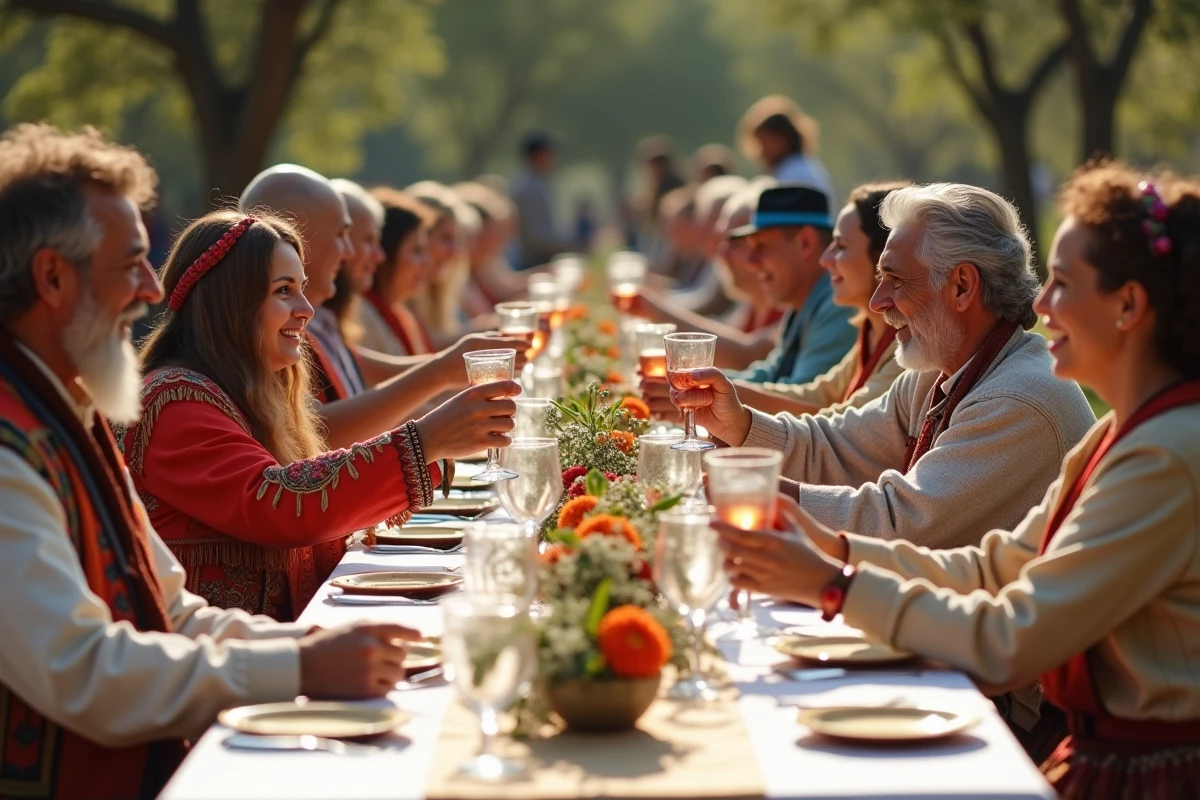
The wedding budget can quickly reach new heights: sometimes record numbers of guests, carefully arranged services, dazzling outfits, and sophisticated decorations are the norm. The festivities can stretch over several days, with each gesture reinforcing the spirit of sharing and solidarity characteristic of the community.
Between heritage and differences: what distinguishes Gypsy marriage from other unions
The diversity of French Gypsy communities gives rise to varied practices, often unknown beyond the family circle. The codes and rituals evolve according to the groups.
Some strong contrasts can be noted:
- The Andalusian Gypsies, cradled by flamenco, orchestrate vibrant celebrations, where the party takes on an almost theatrical turn.
- In evangelical families, ceremonies are much more subdued, centered on faith and community, far from excesses.
- The Roma and Manouches follow different rhythms and priorities: each group leaves its mark on the way they unite.
The media sometimes take an interest in these traditions, revealing to the public spectacular weddings or the dilemmas of couples torn between loyalty to the group and the desire for emancipation: we remember those unions made famous by shows or striking testimonies, where pressure and challenges arise at every stage.
The handkerchief ceremony, a symbol of a divisive heritage, still raises many debates, between identity assertion and desire for change. The story of each marriage tells this delicate balance between anchoring in tradition and affirming personal choices.
The role of women has also become a lively topic. Social media disrupt the image of a woman confined to certain roles, while more and more young women seek to shift the lines within their own families. The evolution is palpable: Gypsy culture reinvents its own boundaries, challenges its certainties, without losing any of its vitality.
Each marriage thus becomes a new chapter. Behind the appearances, there are sometimes radical choices, proud assertions – or breaks with the old order. Nothing is ever really fixed: the celebration bursts forth, words circulate, and already another story begins to be written somewhere on a vacant lot or in the courtyard of a family home.