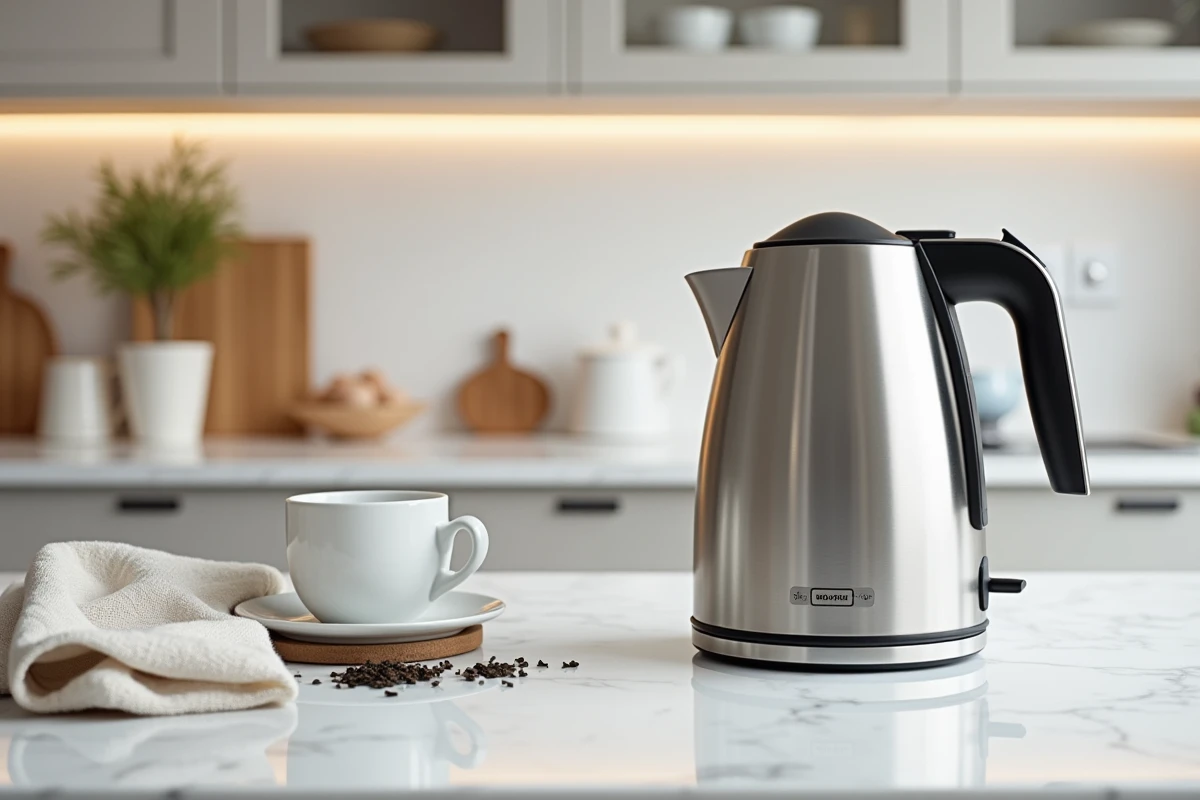
The power of an electric kettle, expressed in watts, determines the speed at which the heating element converts electricity into heat to bring the water to temperature. Consumer models range from 1,000 W to 2,400 W. This range has direct consequences on heating time, but also on compatibility with the electrical installation of the home.
Kettle power and electrical installation: what your meter can handle
A 2,400 W kettle draws about 10 amps on a standard 230 V circuit. In a home equipped with a meter limited to 3 kVA (about 13 A), simultaneously turning on this kettle and a space heater or an oven is enough to trip the circuit breaker.
This scenario is not uncommon in older studios or small apartments where the electrical subscription remains low. Before choosing a very powerful appliance, checking the subscribed power at the meter can avoid many morning inconveniences.
To delve deeper into the relationship between watts, heating time, and technical constraints, the electric kettle power on the Domotica website details the parameters that influence the choice of a model suitable for each configuration.
User feedback compiled in several recent comparisons also indicates that kettles of 2,400 W or more strain low-quality power strips: yellowing of plastic, heating of switches, and even deformation of the casing. The most common recommendation is to plug these models directly into a dedicated wall outlet, without extension cords or power strips.
Watts and kilowatt-hours: power does not dictate total consumption
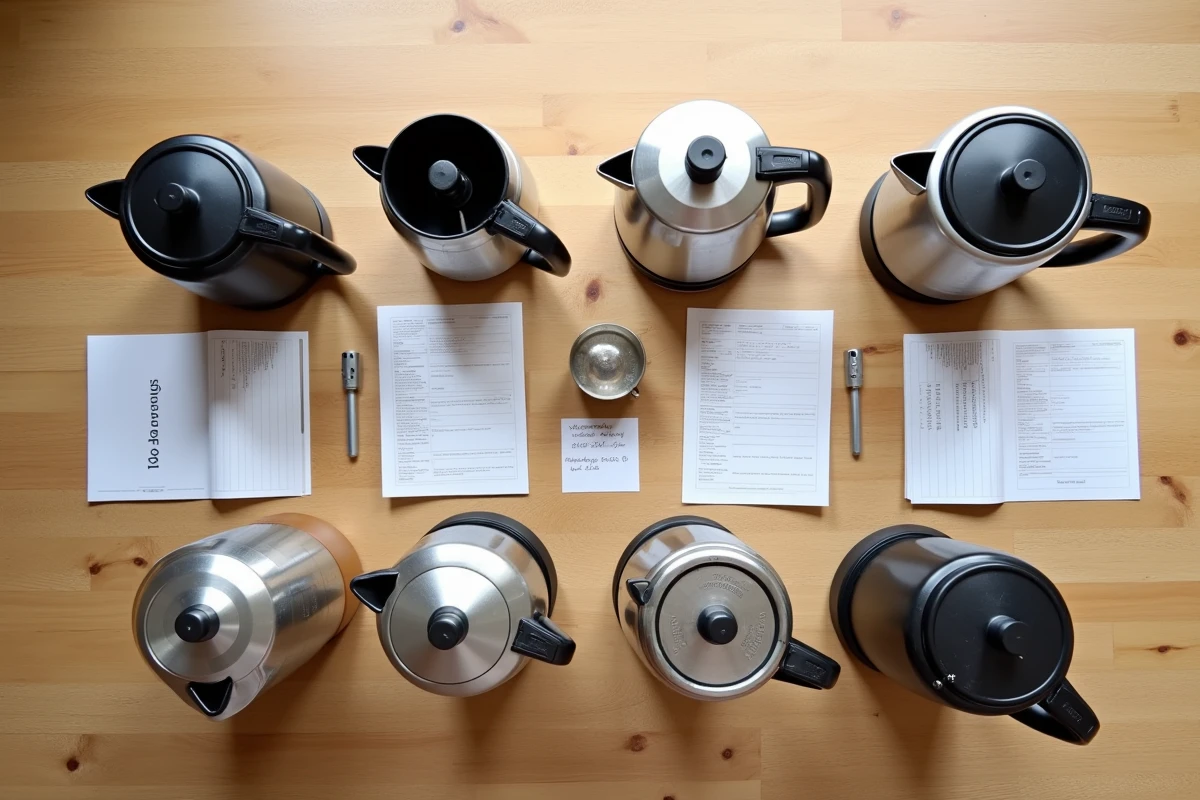
A common misconception is that a more powerful kettle necessarily consumes more energy. Comparative tests published in 2026 show the opposite: at equal water volume, a 1,000 W kettle and a 2,400 W kettle consume roughly the same number of kWh. The latter simply heats up faster.
The explanation lies in basic physics. Heating one liter of water from 20 °C to 100 °C requires a fixed amount of energy, regardless of the power of the appliance. A powerful model achieves this in less time, while a low-power model takes longer, but the energy bill remains comparable.
The parameter that truly impacts annual consumption is the amount of water heated with each use. Consistently filling the kettle to full capacity for just one cup wastes energy. Heating only the necessary volume reduces consumption much more tangibly than choosing a low nominal power.
Cross-reference guide: kettle power according to housing configuration
Not all kettles are suitable for all homes. The table below cross-references the power of the appliance with the type of electrical installation to identify suitable combinations.
| Housing Configuration | Recommended Power | Precaution |
|---|---|---|
| Studio, 3 kVA meter | 1,000 to 1,200 W | Avoid simultaneous use with a high-demand appliance |
| Apartment, 6 kVA meter | 1,500 to 2,200 W | Dedicated wall outlet preferred |
| House, 9 kVA meter or more | 2,200 to 2,400 W | Direct connection, no power strip |
Models around 1,000 to 1,200 W, sometimes referred to as “low power,” appear in the 2026 comparisons as a relevant compromise for older homes or for those who intentionally limit their electrical subscription. Heating time extends by one to two minutes for one liter, an acceptable delay for those who want to avoid repeated tripping.
Capacity and power: a relationship not to be overlooked
A large-capacity kettle (1.5 to 1.7 liters) paired with low power results in long and impractical heating times. Conversely, a small 0.8-liter model does not need 2,400 W to reach boiling in a reasonable time.
- 0.8-liter kettle: a power of 1,000 to 1,500 W is more than sufficient for two cups in a few minutes.
- 1.2-liter kettle: the range of 1,500 to 2,000 W offers a good balance between speed and circuit demand.
- 1.5 to 1.7-liter kettle: below 2,000 W, the heating time for a full fill often exceeds four minutes, which can be annoying on a daily basis.
Adjustable temperature and materials: two criteria linked to power
Kettles with adjustable temperature offer intermediate heating levels, often between 40 °C and 90 °C. Green leaf tea infuses around 70 °C, while classic black tea infuses around 90 °C. Heating to 80 °C instead of bringing the water to a boil saves a significant amount of energy over the year.
The material of the body (stainless steel, glass, plastic) does not directly affect power, but it influences heat dissipation. A glass or stainless steel kettle retains heat better than a thin plastic model, which reduces reheating cycles for tea drinkers who go through multiple cups.
The anti-limescale filter, a discreet ally of performance
Limescale that accumulates on the heating element acts as a thermal insulator. A scaled kettle takes longer to heat and consumes more for the same result. Regular descaling and an anti-limescale filter keep the effective power of the appliance close to its nominal power.
Choosing an electric kettle is not just about comparing watt figures on a product sheet. The subscribed power at the meter, the type of connection, the actual capacity used each day, and the maintenance of the filter weigh as much as the nominal power on the daily experience and the electricity bill.